
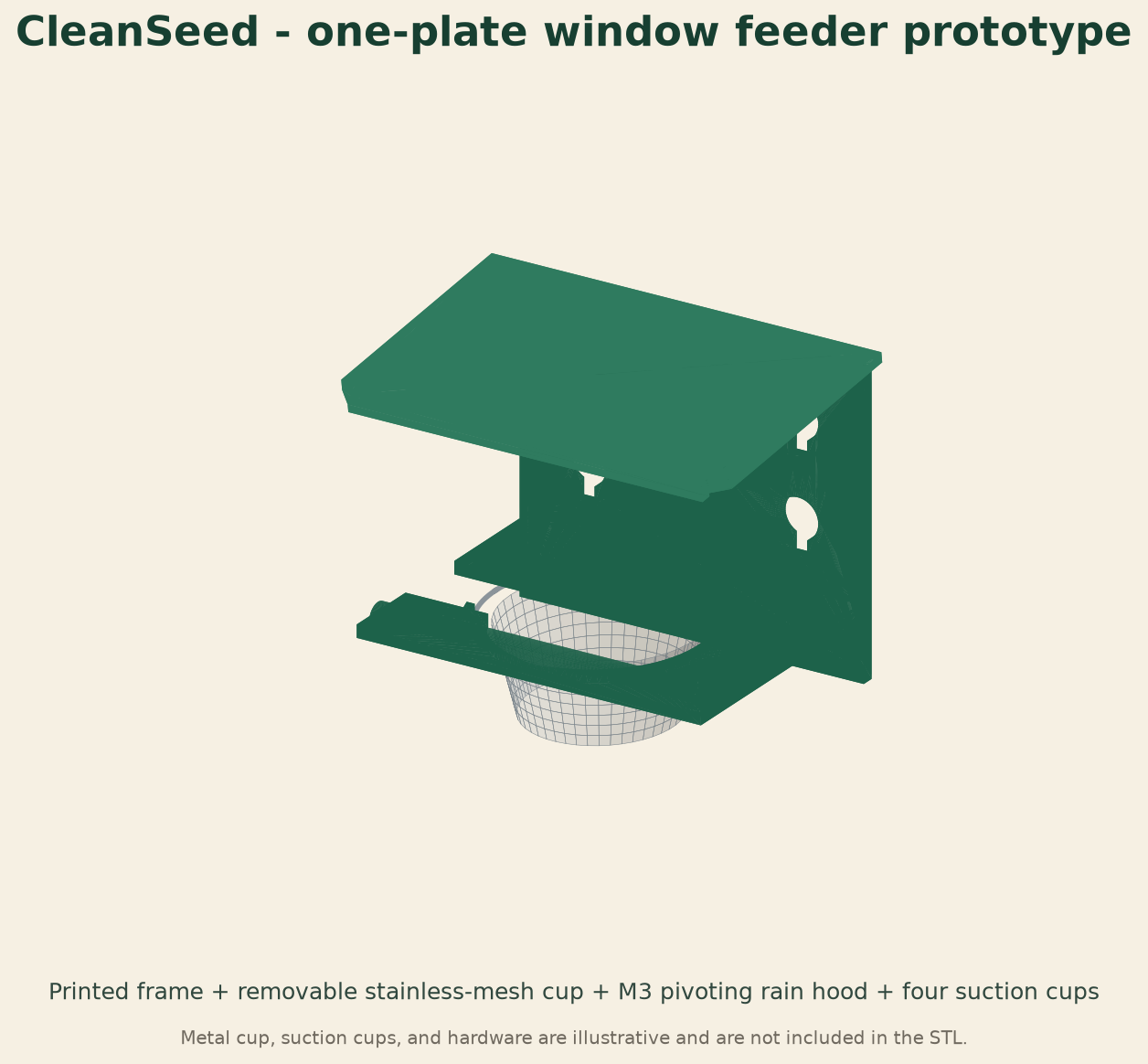
The easy version of a printed feeder is a tray with seed poured into it. That is also the part that becomes awkward to clean: every corner, seam, and layer line becomes part of the food-contact surface. CleanSeed starts with a different constraint. The printed frame supports the feeder, but a removable stainless-mesh cup holds the seed.
That single decision shaped everything else. The frame can stay on the glass. The cup lifts straight out. Mesh provides drainage without asking printed holes to do all the work. The cup can be washed and dried separately, and it can be replaced without reprinting the frame.
Digitally checked is not field tested
Revision one has not been physically sliced, printed, mounted, weathered, cleaned, or used around birds. It makes no claim of suction retention, weather resistance, food-contact certification, squirrel resistance, species preference, or window-collision prevention. The download includes the missing physical gates so this prototype cannot be mistaken for a finished product.
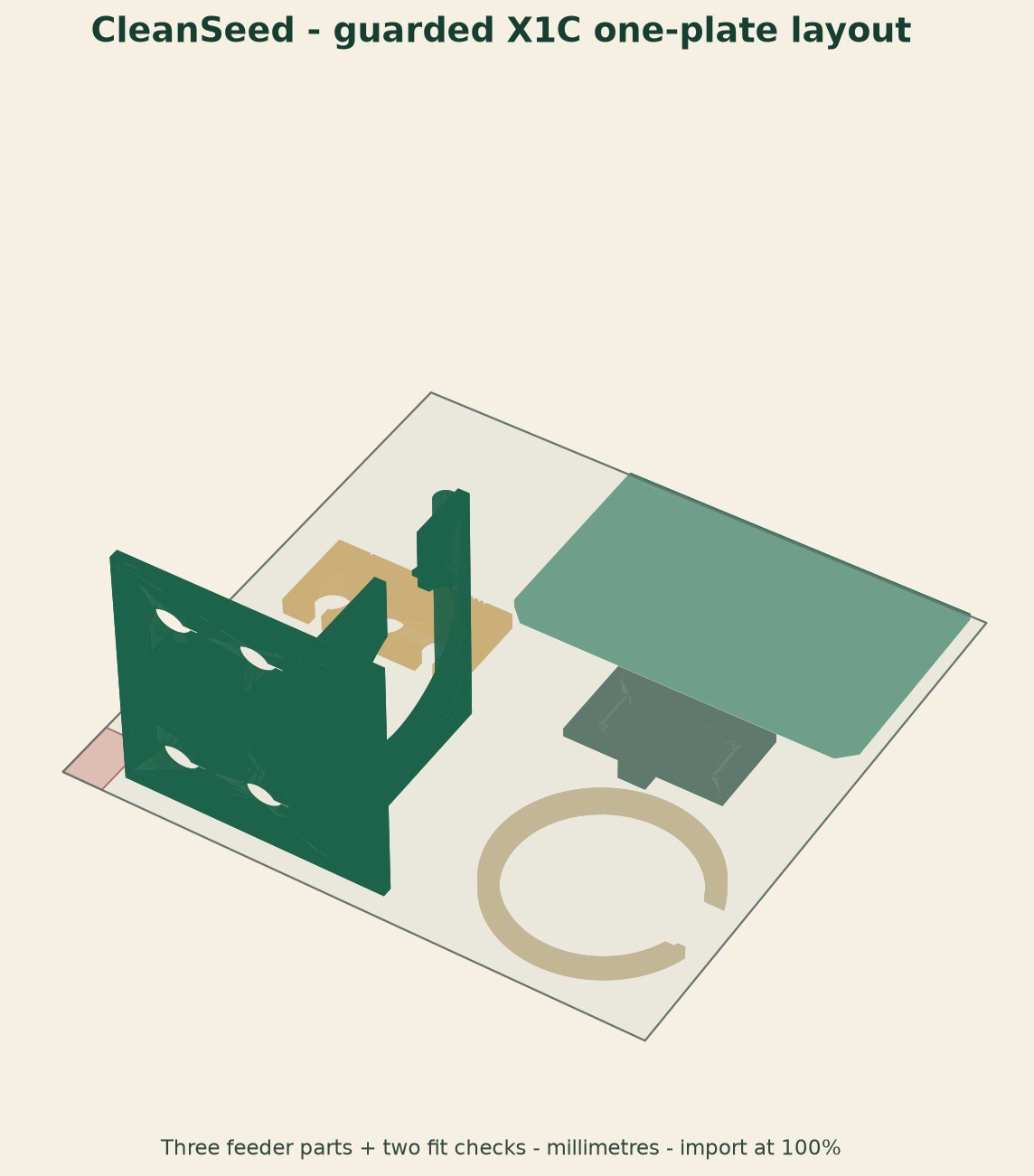
Three feeder parts, two fit checks, one X1C plate
The feeder itself has three printed parts: a one-piece side-printed frame, a flat rain hood, and a central M3 hinge spine. The other two objects are deliberate test pieces: a full-size cup-seat ring and a card for M3 insert pockets and suction-cup stems.
The mounted frame is 136 mm wide, 101 mm deep at the landing rail, and 116 mm high. Its hood is 154 × 94 mm and locks at a seven-degree forward slope. The guarded plate arrangement measures 228 × 244 × 136 mm. It stays inside the nominal X1C build envelope documented in Bambu Lab’s X1-Carbon specifications, but a real Bambu Studio slice is still required.
Download revision one
The ZIP is free and direct. It includes separate STLs, a generic five-mesh 3MF, an equivalent five-volume plate STL, editable STEP, parametric CadQuery source, assembly and cleaning diagrams, instructions, and the generated validation report.
CleanSeed window feeder M3
Three feeder parts, two fit checks, X1C 3MF, STL, STEP, source, previews, README, and digital validation report · 1.07 MB
The non-printed parts are part of the design
The starting interface is an 84 mm nominal stainless-mesh cup whose body is under 76 mm. Four generic flat-head suction cups begin at 40 mm diameter, with a head under 16 mm and a stem near 7.2 mm. The hinge uses seven M3 × 6 × 5 mm nominal heat-set inserts, four M3 × 12 mm hood bolts, and three M3 × 20 mm pivot-and-lock bolts.
Those are interface targets, not a shopping guarantee. Supplier dimensions vary. The full-size ring checks whether the actual cup body clears and the rim seats. The card checks 6.2, 7.2, and 8.2 mm suction stems plus 4.0, 4.2, and 4.4 mm M3 pilot pockets. If the real parts do not fit the gauges, change the named constants and regenerate before printing the frame.
The hood pivots, then locks
Four M3 bolts fasten the broad spine foot to inserts under the hood. One upper M3 bolt becomes the pivot. Two lower bolts lock the hood in its rain-shedding position. Supporting the hood and removing both lower bolts lets it rotate around the upper bolt for cleaning; both locks go back before the feeder is loaded.
Every heat-set pocket is blind. The starting 4.2 mm pilot has a 5.2 mm entry flare and 6.6 mm depth. That geometry passed the digital material-floor checks, but only the supplied coupon can show what a particular printer, filament, layer profile, and insert lot do in the real world.
The washable part lifts out
Project FeederWatch’s feeder-care guidance recommends cleaning seed and suet feeders every week or two, more often in wet weather or heavy use. Its process is practical: take the feeder apart, scrub away debris, wash with warm water and dish soap, rinse thoroughly, and let everything dry completely.
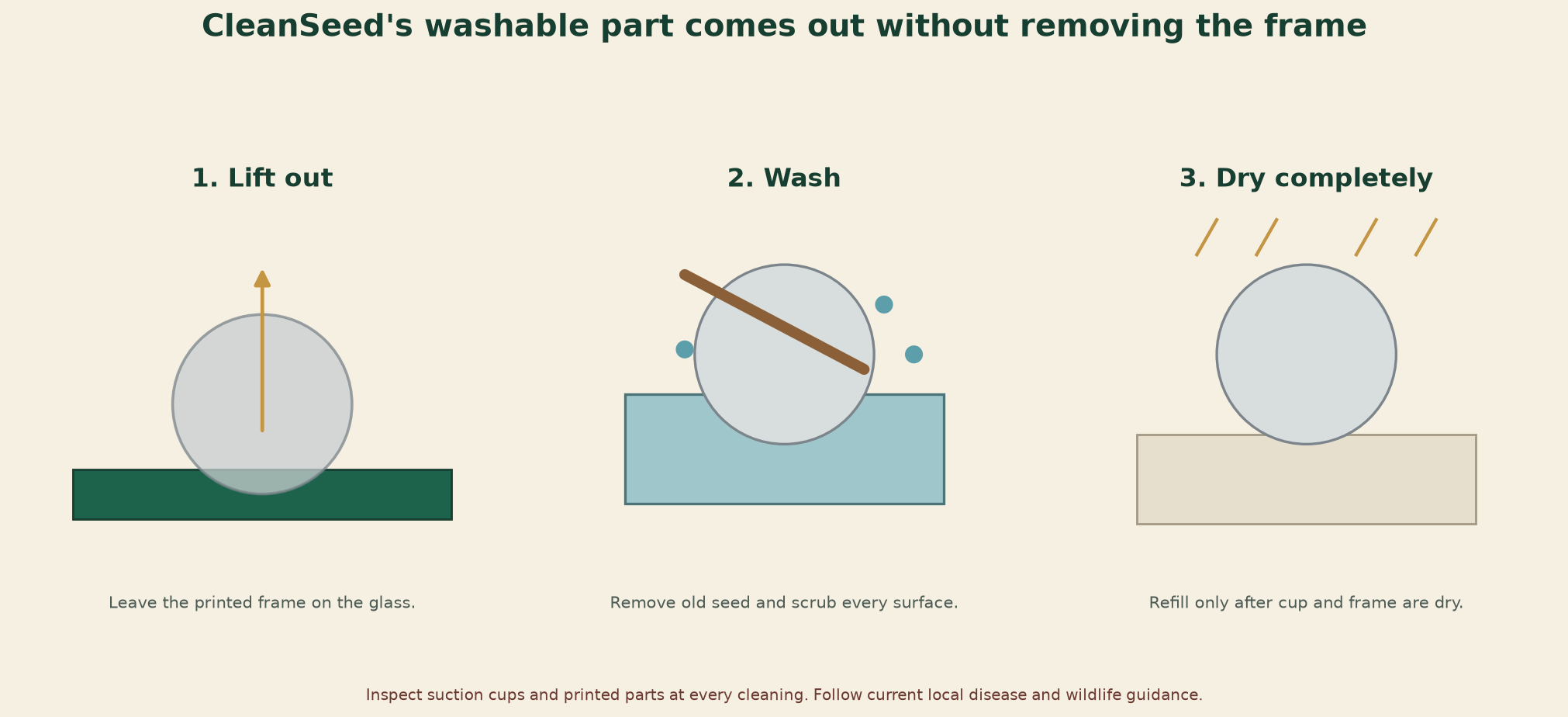
The removable cup does not make the rest of the feeder self-cleaning. Hulls, droppings, moisture, and dust still reach the frame. Retire a part that cannot be cleaned or that shows cracks, rough splinters, creep, loose inserts, or deformation. Follow current local wildlife and disease guidance and pause feeding when authorities advise it.
Treat the window before considering feeder use
A window feeder does not make glass visible to a bird. Cornell Lab’s current window-collision guidance says windows near feeders should receive effective exterior treatments such as correctly spaced patterns, screens, or cords. Older distance-only rules are not a substitute for treating the outside of the same pane.
That exterior treatment is a release gate, alongside a 24-hour proof load over a safe padded area, a seven-day loaded-window retention test, rain drainage, wind response, ten cleaning cycles, outdoor temperature and UV exposure, and hinge durability. Any slip, crack, warp, loose insert, cup movement, or repeated collision stops the experiment.
What the digital files prove
The generated checks confirm five watertight single-component STLs, a millimetre-native five-mesh 3MF, a five-solid STEP, non-overlapping placement, cutter-corner clearance, the 228 × 244 × 136 mm plate envelope, four suction receivers, a full-size cup gauge, and solid floors behind all seven M3 pockets.
They do not prove slicer support behavior, print quality, insert strength, suction performance, cleaning effectiveness, weather resistance, wildlife suitability, or field safety. Those are observations to collect next, not adjectives to put on a download page.
Help test revision one
Print the two gauges before the feeder.
The most useful report includes measured cup and suction dimensions, printer, material, layer profile, selected M3 pocket, slice warnings, proof-load result, and exactly where fit or retention failed.
Share CleanSeed feedback