
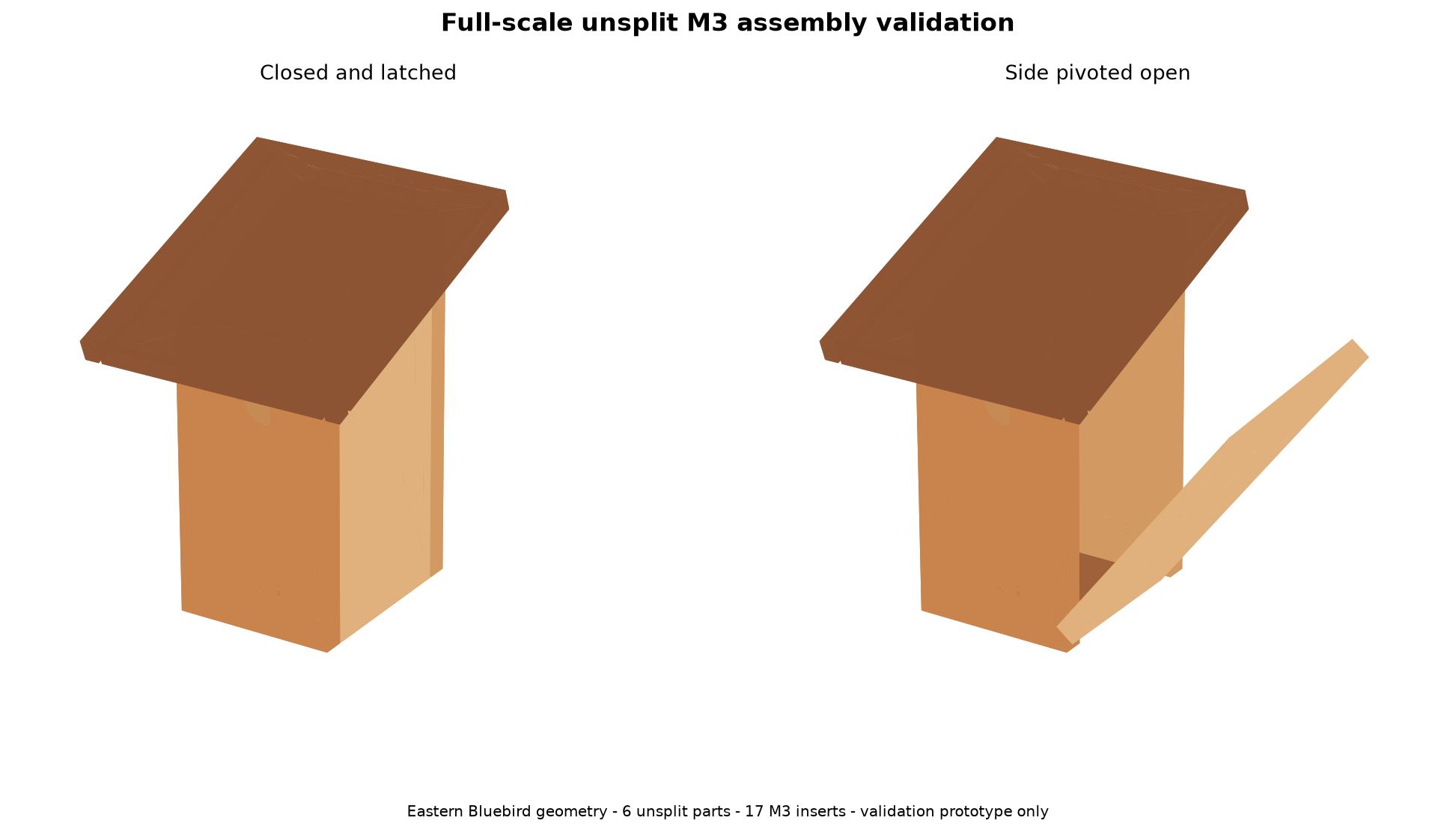
The original Make Birdhouses idea is still a pre-cut wood kit. These plastic files serve a different purpose: they let us check the geometry, instructions, hardware access, insert fit, cleanout motion, and assembly sequence before treating any design choice as settled.
First, the important limitation
These are experimental prototype files supplied without warranty. A full-size cavity is not the same thing as a suitable nest box. Printed thermoplastic has not passed the thermal, moisture, condensation, UV, cleaning, durability, predator-loading, or species-review gates required for live-bird occupancy. Do not install these prints for birds.
Choose the package that answers your question
Every ZIP includes its own README. Import the models in millimetres at 100%, print the fit coupon before a hardware-heavy build, and do not use a slicer’s scale-to-fit command.
Full-scale X1C, unsplit M3
Four 3MF plates, six whole parts, 17 M3 joints, STEP, STLs, fit coupon, previews, and validation report · 1.24 MB
Full-scale modular M3
Eleven parts for a 220 × 220 × 250 mm envelope, 29 M3 inserts, STEP, STLs, fit coupon, and previews · 0.85 MB
36% M2 hardware mockup
Compact insert, bolt, hinge, and latch practice with 15 M2 joints and a fit coupon · 0.62 MB
36% geometry mockup
The quickest no-hardware check: six parts in one STL plus editable STEP, preview, and instructions · 0.18 MB
If you have an X1C and M3 hardware
Start with the unsplit X1C package. Print the M3 orientation coupon first and test the 4.0, 4.2, and 4.4 mm pilot pockets with the actual insert lot and filament. The model starts at a 4.2 mm pocket for an M3 × 6 × 5 mm heat-set insert, but printed-hole behavior varies enough that the coupon result should win.
The supplied four 3MF plates keep all six birdhouse parts whole and cap the modeled part height at 245 mm. Use a brim only where the README calls for one, inspect the supports layer by layer, and do not disable an X1C exclusion-area, height, or collision safeguard to force the print.
Why there is no one-plate X1C file
Keeping full scale, the original 19.05 mm wall thickness, six separate unsplit parts, and credible support faces makes a one-plate arrangement physically implausible. The six conservative print envelopes total 1.876 times the nominal X1C plate area before adding brims, supports, clearance, or the cutter exclusion. Four guarded plates are the honest fallback.
What has been checked—and what has not
The X1C package has passed generated geometry checks for six watertight single-volume parts, four valid generic 3MF archives, plate bounds, a six-solid STEP, 17 aligned M3 insert-and-bolt pairs, cleanout-side clearance, and modeled motion through 60 degrees.
That is digital validation only. It has not yet passed a real Bambu Studio slice, an X1C print, heat-set installation, physical assembly, wet/dry exposure, thermal comparison, UV aging, cleaning, or occupancy review. The modular M3 and smaller mockups carry the same basic limitation: a useful model is not a finished product.
Useful feedback from a real print
If you try one, the most valuable report is concrete: printer and material, layer profile, fit-coupon result, support behavior, insert seating, bolt length, hinge motion, binding, layer damage, and any hole that needs to move. Photos of the coupon, plate preview, and assembled cleanout side are especially useful.
Help improve revision two
Tell us what the print taught you.
A concise failure report is more valuable than a thumbs-up. Include the package name, printer, filament, slicer settings, and the first place the design stopped behaving as expected.
Share print feedback