
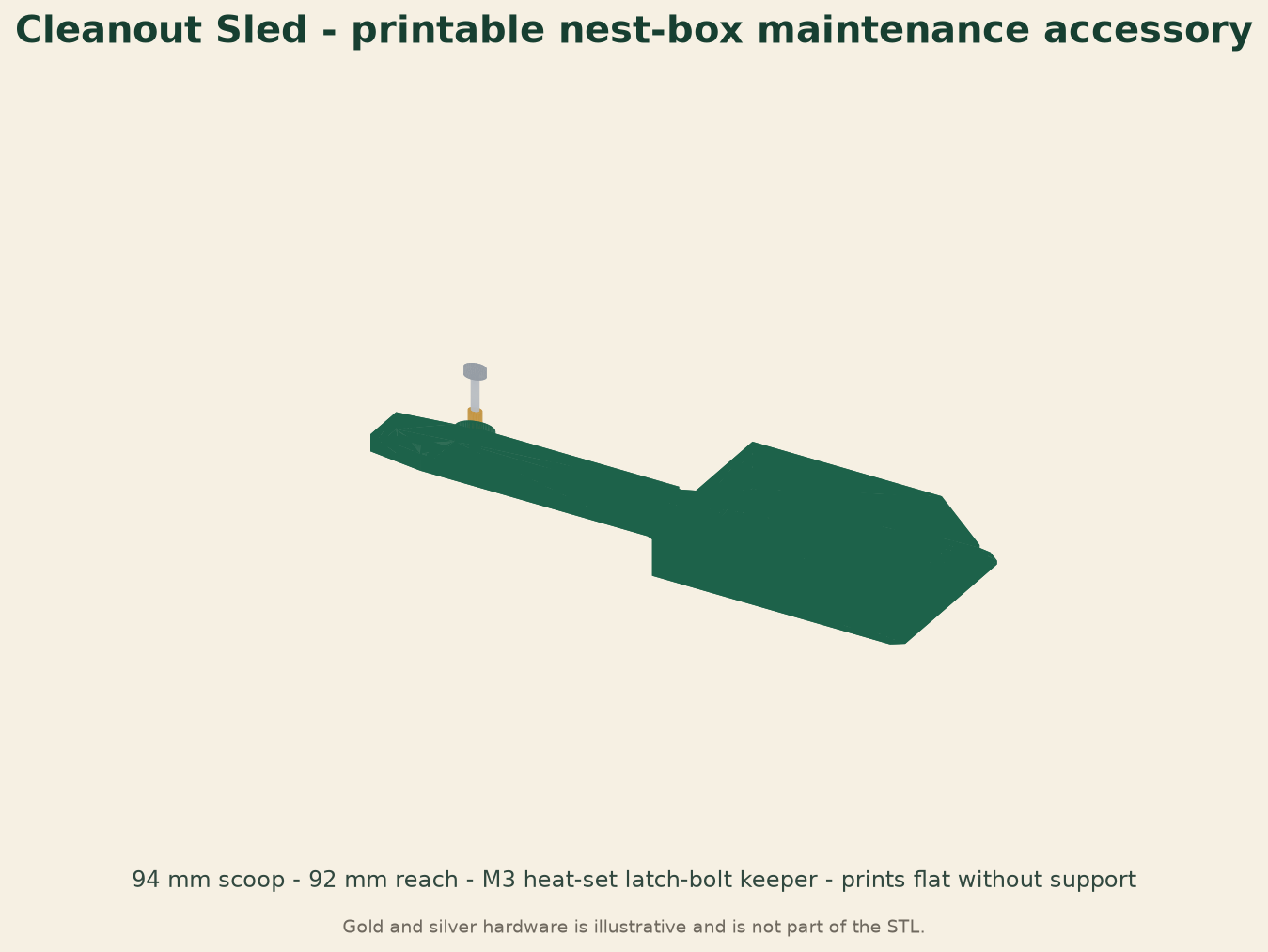
The Backyard Box already has a hinged cleanout side. The new question was what could make that opening more useful without changing the entrance, ventilation, drainage, roof, or nest cavity. The answer became the Cleanout Sled: a temporary hand tool that reaches through the open side, lifts old nesting material, and keeps the removed latch bolt from disappearing into the grass.
Use only on a confirmed unoccupied box
This tool is not a permanent birdhouse part and must never be left in or attached to the box. Do not use it around an active nest, eggs, nestlings, adult birds, wasps, bees, or any other occupant. Cornell Lab NestWatch says cleanout should happen only when there is absolutely no sign of breeding activity; if you are unsure, wait.
The design in one pass
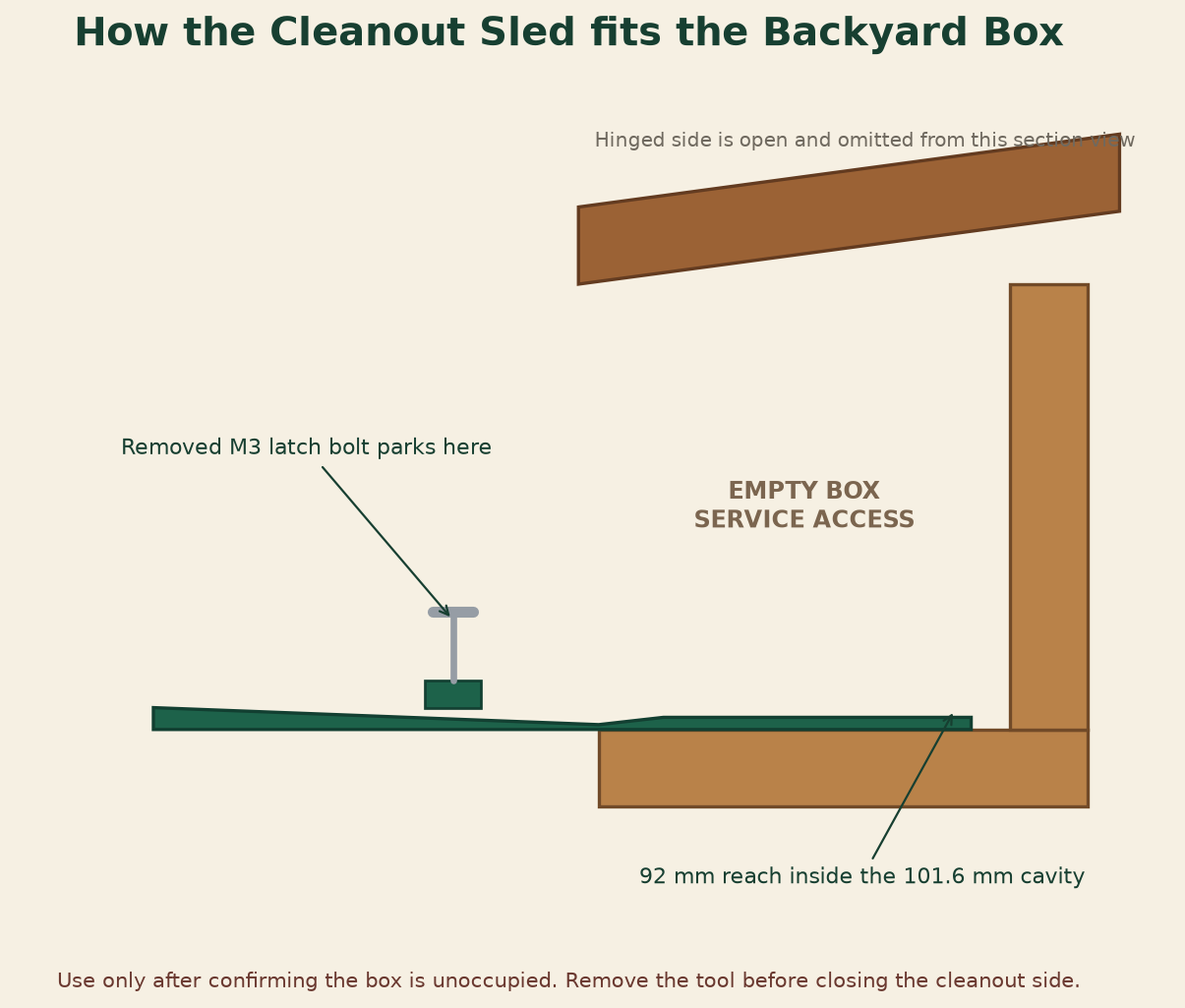
The scoop is 94 mm wide, with a 92 mm reach and a 1.2 mm leading lip. The full-scale Backyard Box has a nominal 136.525 mm side opening and a 101.6 mm interior width. In the CAD, that leaves 42.525 mm of total opening clearance and 9.6 mm between the nose and the far wall.
Low side rails rise behind the thin nose so loose material stays on the scoop. A broad shoulder carries the load into a 5.4 mm handle. The raised 14 mm boss accepts the same M3 × 6 × 5 mm heat-set insert used by the full-scale prototype, with a 4.2 mm starting pocket, 5.2 mm entry flare, and 6.6 mm blind depth.
Download revision one
The ZIP is free and direct. It contains the one-piece STL, a guarded one-plate X1C 3MF, an equivalent plate STL, editable STEP, a three-size M3 fit coupon, two diagrams, the parametric CadQuery source, and the generated validation report.
Cleanout Sled M3 accessory
One support-free accessory plus fit coupon, X1C 3MF, STL, STEP, source, previews, instructions, and digital validation report · 0.40 MB
Print it on the X1C
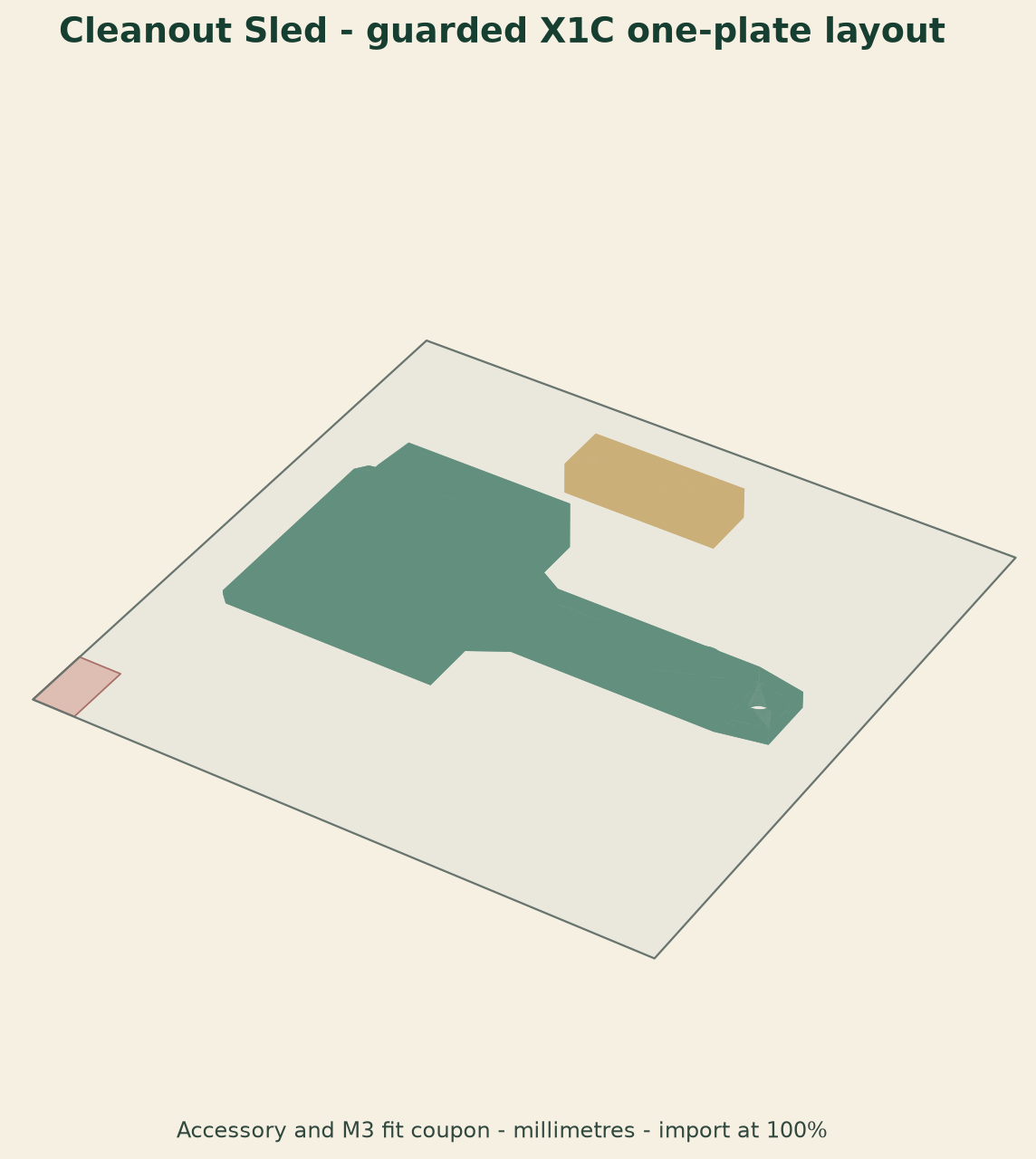
The supplied generic 3MF places the accessory and fit coupon on one X1C plate, inside the nominal 256 × 256 mm area and away from the conservative front-left cutter corner. Import at 100% in millimetres. The designed orientation is flat and does not require support.
A reasonable first test is PETG, a 0.20 or 0.24 mm layer height, four to six wall loops, five top and bottom layers, and 20% to 30% gyroid or cubic infill. Add a small brim only if the thin nose or broad handle lifts. Inspect the complete slice before printing and do not disable a bounds, exclusion-area, or collision warning to force the file.
Fit the insert before trusting the keeper
Printed holes change with filament, extrusion width, layer profile, and machine calibration. The coupon provides 4.0, 4.2, and 4.4 mm top-entry pockets, identified by one, two, and three notches. Use the smallest pilot that accepts the actual insert without cracking, excessive bulging, rotation, or pullout. If the default 4.2 mm pocket is wrong, change the generator before printing the accessory.
After the part cools, thread the actual latch bolt into the keeper by hand. It should engage without bottoming in the blind pocket or turning the insert. During service, park the bolt only finger-tight; the boss is storage, not a high-torque joint.
Use it as a service tool, then take it away
- Confirm there is absolutely no breeding activity. If uncertain, stop.
- Wear appropriate gloves and follow current nest-box hygiene guidance.
- Open the cleanout side, remove the upper M3 latch bolt, and thread it lightly into the keeper.
- Slide the thin nose along the floor and remove old material in controlled passes. Do not pry against the box.
- Wash the tool separately, inspect the empty box, reinstall the latch, and confirm the tool is not in or attached to the box.
For the timing and care of nest-box cleanout, start with Cornell Lab NestWatch’s post-fledging cleanout guidance. The broader design rationale follows NestWatch’s recommendation that a good box be easy to monitor and clean.
What the file proves—and what it does not
The generated checks confirm a watertight single-volume accessory STL, a watertight coupon, a millimetre-native two-mesh 3MF, a two-solid STEP, X1C plate bounds, non-overlap, cutter-corner clearance, nominal box fit, and at least 4.9 mm of radial material around the blind M3 pocket.
Revision one has not yet passed a real Bambu Studio slice, physical X1C print, heat-set installation, washability test, repeated removal of real nest material, outdoor aging, or field review by a nest-box monitor. Those missing checks are included in the download instead of being hidden behind a finished-product claim.
Help test revision one
Print the coupon first. Then tell us what failed.
The most useful note includes the printer, material, layer profile, selected insert pocket, whether the nose stayed flat, and where the real tool did or did not fit the box.
Share Cleanout Sled feedback